

PMHNP Market Pulse
Trusted by 10,000+ PMHNPs · Issue #1 · Feb 26, 2026
You’re staring at two paths that both end with “PMHNP” in your signature—one just adds a few more letters (and a bigger tuition bill). Meanwhile, job postings look nearly identical, and you’re wondering if the extra school actually shows up in your paycheck.
THE QUICK TAKE
The “$10–20K bump” is real—but not automatic
Across many postings, DNP-prepared candidates show up around $10–20K/year higher than MSN. The catch: it’s most consistent in organizations with defined pay bands (health systems, large groups, some FQHCs) and much less consistent in smaller practices.
Delay can erase the raise
A “middle-of-the-road” lift (say $15K/year) can disappear fast if the DNP route delays full-time earning by a year or forces you to cut hours during school.
Break-even is the clean ROI test
Add tuition + loan costs + lost income, then divide by your realistic annual lift. That gives you your break-even time—often anywhere from ~3 years to 7+ years depending on total cost and how much the market actually pays for the doctorate.
Telehealth usually prices performance, not degrees
Remote roles can pay well, but the driver is often experience, licensure footprint, throughput, and documentation speed—not DNP vs MSN. Comparing telehealth PMHNP jobs vs remote PMHNP jobs helps you see what employers are really rewarding.
ONE NUMBER THAT MATTERS
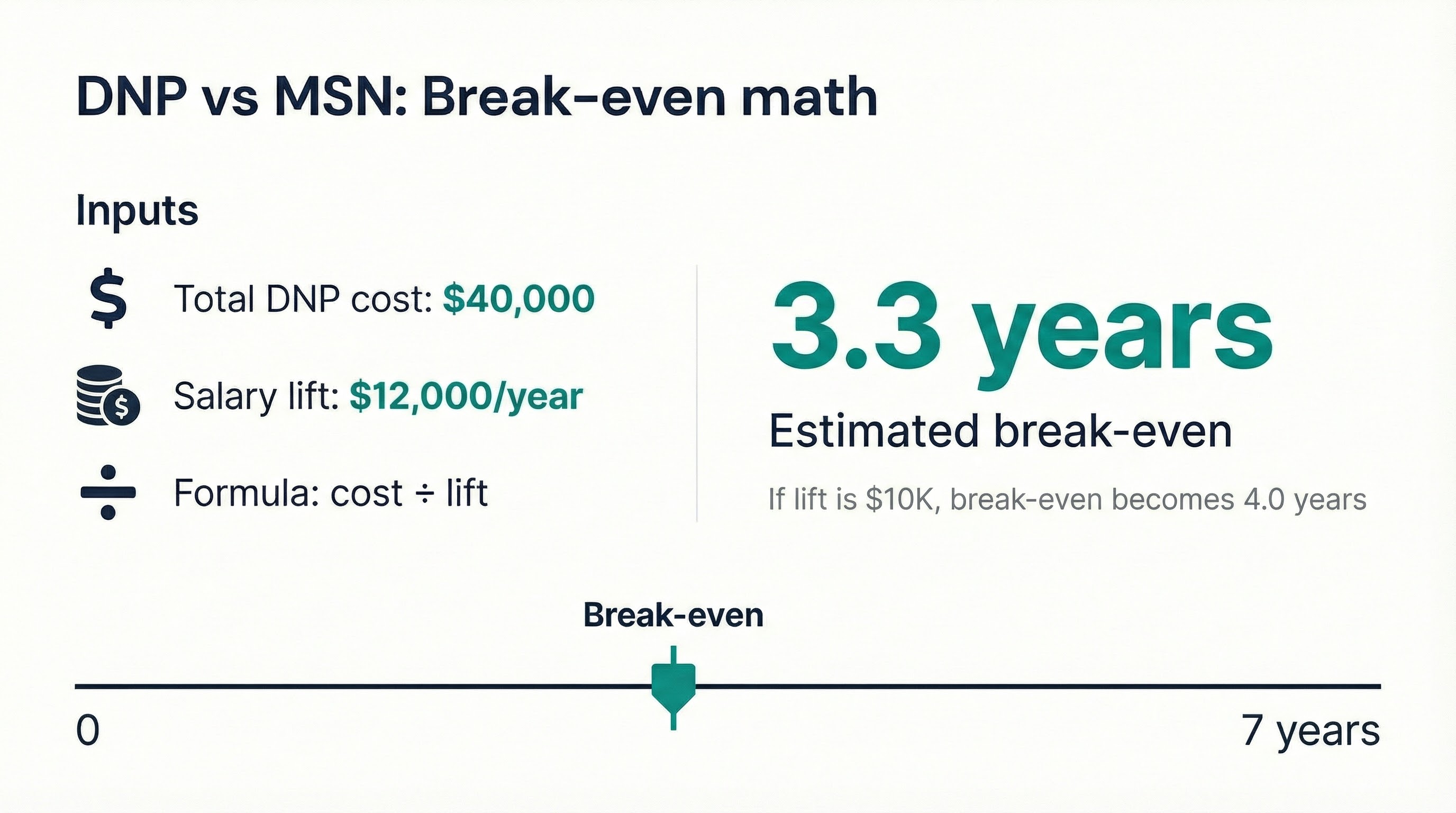
3.3 years
If your total DNP cost is $40,000 and your realistic salary lift is $12,000/year, your break-even is about 3.3 years. That’s the simplest way to decide if the extra degree is paying you back—or just extending your runway.
WHAT TO DO WITH THIS
Pick your “must-have” role three years from now and check whether it truly requires a doctorate (or just says “preferred”). Then run a conservative break-even: use a $10K lift unless your target employers consistently show more.
When you’re interviewing, ask two direct questions: “Do you have a formal degree differential?” and “Does DNP change my pay band, bonus eligibility, or leadership ladder?” You’ll get clearer answers than trying to infer it from the posting.
When you’re interviewing, ask two direct questions: “Do you have a formal degree differential?” and “Does DNP change my pay band, bonus eligibility, or leadership ladder?” You’ll get clearer answers than trying to infer it from the posting.
JOBS THIS WEEK
Talkiatry — Remote (Multi-state) · Telehealth · $145K–$175K
VA Health System — Los Angeles, CA · In-person/Hybrid · $140K–$170K
Community Care Partners (FQHC) — Boston, MA · Outpatient · $135K–$160K
Note: examples are illustrative to help your search and are not guaranteed live listings.
🔔 Don't miss your next role.
Get matching PMHNP jobs sent to your inbox so you’re not refreshing listings between patients.
Get matching PMHNP jobs sent to your inbox so you’re not refreshing listings between patients.
💬 Quick question:
In your area, do employers actually pay more for a DNP—or is pay mostly driven by setting/volume? Hit reply — we read every response and may feature yours (anonymously) next week.
In your area, do employers actually pay more for a DNP—or is pay mostly driven by setting/volume? Hit reply — we read every response and may feature yours (anonymously) next week.
— The PMHNP Hiring Team
P.S. If you’re running the math right now, pull a few comparable postings from pmhnphiring.com/jobs and use the low end of the range for your break-even. It keeps the decision grounded.
Know a PMHNP who'd find this useful?
Forward this email or share the signup link:
newsletter.pmhnphiring.com